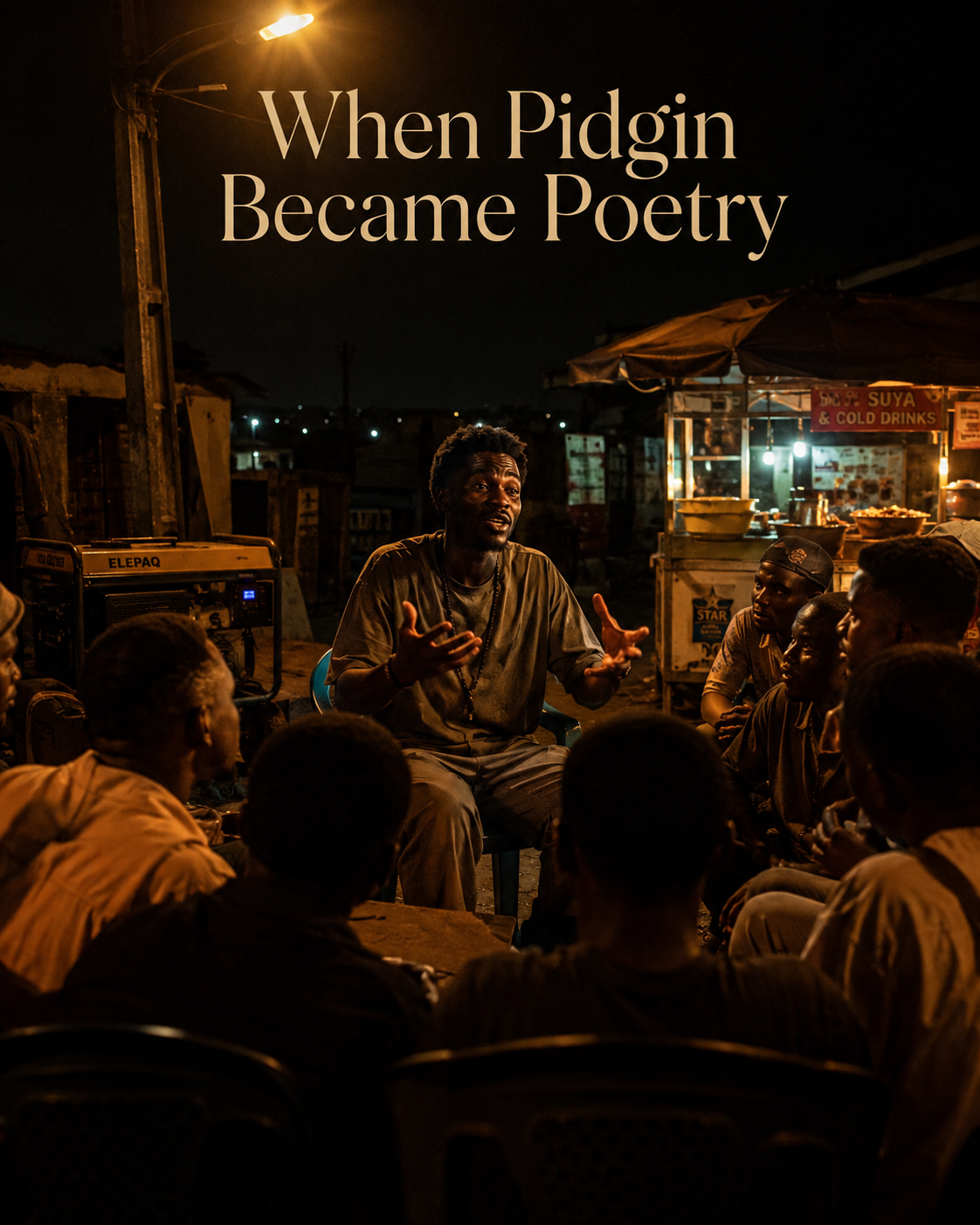
There is a sentence my uncle used to say whenever something surprised him. Not in English, not in Igbo, but in Pidgin, fast and sharp and perfectly timed. I could never translate it exactly. That was always the point. Some things only land in the language they were born in.
Nigerian Pidgin did not begin as anyone's mother tongue. It started as a workaround, a bridge language stitched together on the coastlines of trade, where British merchants and Nigerian middlemen needed just enough shared words to exchange goods without misunderstanding. It was practical. Functional. Nobody was writing poems in it.
For a long time, that was how it stayed. Pidgin was the language of the market, the bus park, the street. It was what you spoke when you did not share a tribe with the person next to you. In a country with over five hundred languages, it became the unofficial common ground, not taught in schools, not written in textbooks, but passed down through proximity and necessity. You learned it by being Nigerian.
The interesting thing about a language that belongs to no single group is that it belongs to everyone. And when something belongs to everyone, people stop being careful with it. They start playing. They start bending it, stretching it, loading it with meaning it was never designed to carry. That is when a utility becomes an art form.
Listen to how Pidgin handles emotion. English says "I am tired." Pidgin says "I don tire." The dropped syllables are not laziness. They are rhythm. They carry a weight that the grammatically correct version somehow misses, the full-body exhaustion of a person who has been going too long. Or take "E be like say," which translates roughly to "it seems as though," but lands with a softness, an almost philosophical resignation, that no English phrase quite captures. Pidgin does not just communicate. It performs.
This is why musicians understood it before academics did. Fela Kuti built an entire career on the power of Pidgin to say things that would have been too dangerous in English or too exclusionary in Yoruba alone. Singing to all of Nigeria meant singing in the one language all of Nigeria shared. When he sang about suffering and government and the ordinary man's dignity, Pidgin was not a stylistic choice. It was a political one. It made the message impossible to contain within one region or one ethnic group. It made it everybody's problem.
That tradition did not end with Fela. Listen to Burna Boy, Wizkid, Naira Marley, and you hear Pidgin not as a compromise but as a first choice, a language that carries cool and pain and humor and defiance all at once. The global audience that now consumes Afrobeats is not just hearing Nigerian music. They are hearing Nigerian Pidgin, a language that was once considered too rough for formal spaces, now playing in cars and apartments across Europe and America.
But music is only part of it. Pidgin has been quietly moving into literature, into spoken word, into social media, into the everyday writing of young Nigerians who are done apologizing for how they talk. There is a generation that does not see Pidgin as a lesser version of English. They see it as its own thing entirely, with its own logic, its own beauty, its own capacity for precision. When a Nigerian writer drops into Pidgin mid-sentence, it is not a lapse. It is a choice. It is emphasis. It is the moment the feeling becomes too specific for borrowed language.
What changed was not the language. What changed was who was allowed to take it seriously.
My uncle never thought of himself as poetic. He was a loud man who laughed at his own jokes and drove too fast on bad roads. But there were moments, usually late in the evening when the generator was off and the conversation had slowed, when he would say something in Pidgin so exact, so perfectly weighted, that the whole room would go quiet for a second before someone laughed or nodded. He was not quoting anyone. He was just speaking. But it landed like a line someone had spent years writing.
That is what Pidgin became. Not despite its origins in trade and transaction. Because of them. A language forged in the need to be understood, across difference, across distance, across everything that should have kept people from connecting, turned out to be exactly the kind of language that could carry anything. Even poetry. Especially poetry.