
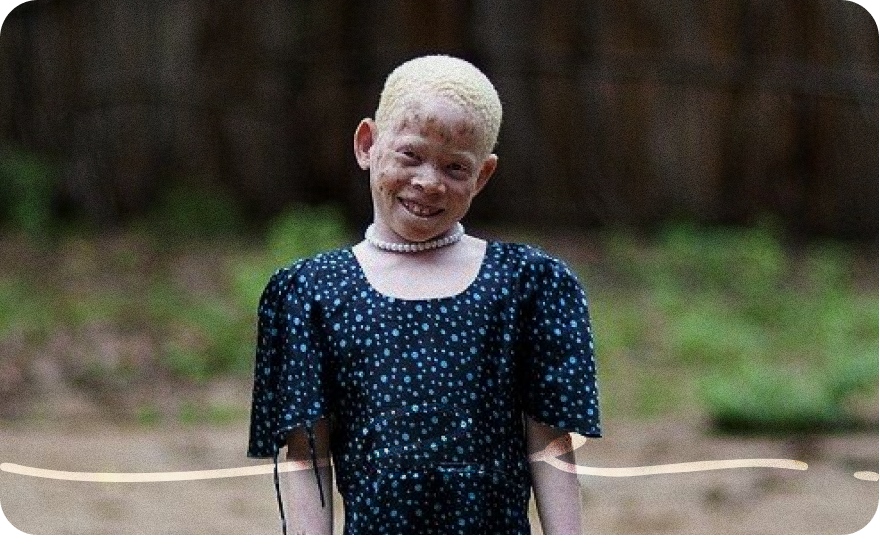
The morning sun always seemed to catch her first as we streamed through the secondary school gates in our neatly pressed uniforms, talking and laughing in tight-knit groups, she was already there. She was not a student, but a homeless teenager whose makeshift shelter stood a stone’s throw from our school gate. Every morning, she was there looking hungry and dejected. Every afternoon, as we walked back home, she was still there.
Rumors had it that she had been sent away by her family because she was a witch, and nobody seemed to question the story; we all accepted it because everyone else did. But looking back now, I see the quiet machinery of prejudice at work: in the minds of many teachers and students like me, her albinism became proof of the rumors. And so, we were told to avoid her. Sometimes we laughed at her, sometimes we made cruel remarks as we passed by, but today, those moments fill me with so much shame. I used to watch her from a distance and wonder what kind of suffering could leave a teenager alone beside a road. What fears did she carry? What loneliness accompanied her every night? What rejection had she endured before she became a rumor that people told their children? At the time, I did not have the language to understand what I was witnessing. Today, I do, what isolated that girl was not albinism itself, it was stigma.
In many African societies, people with albinism are among the most visible members of the community. Their skin, hair, and features make them stand out in environments where most people share similar pigmentation. They are noticed in classrooms, markets, churches, workplaces, and on crowded streets. Strangers stare, children point, questions are asked, and assumptions are made. Yet, for all this visibility, they often remain unseen. Their appearance is recognized long before their personalities; their bodies become sites of curiosity, fascination, superstition, and sometimes fear. Society notices their difference but rarely pauses to understand their lived experiences. This is the paradox of albinism: being too visible to be invisible.
For generations, albinism has been burdened with stories that have little to do with genetics and everything to do with ignorance. Across communities, myths and misconceptions continue to shape how people with albinism are perceived. Some are viewed through a lens of superstition, others are treated as spectacles, and many are forced to navigate a world that sees their appearance before it sees their humanity. The consequences of these misconceptions are far from harmless; they shape the way children are treated in schools, and they influence how families respond to a child born with albinism. They affect friendships, opportunities, and self-worth. In extreme cases, they lead to rejection and isolation, much like the girl who lived outside my secondary school gate.
One of the most frustrating contradictions surrounding albinism is that discrimination comes from their fellow Africans, people who would never tolerate racism or other forms of prejudice. They proudly champion equality, but still feel comfortable making jokes about albinism, asking invasive questions, or reducing people with albinism to stereotypes. This preconception may look different, but it is prejudice nonetheless. The same society that condemns discrimination in one form often overlooks it in another. This contradiction becomes especially visible in entertainment and social media. We live in an age where representation has never been more important, yet some portrayals of albinism continue to reinforce the very stereotypes that have marginalized the community for generations. Comedy skits frequently turn people with albinism into punchlines; their appearance becomes the joke, their condition becomes a prop for cheap laughs. I do not find these portrayals funny; if anything, I find them disturbing. In a society where misinformation about albinism already thrives, such representations do not challenge ignorance; they feed it, and they encourage audiences to laugh at misconceptions rather than question them, and also transform real people into caricatures.
What makes this even more disappointing is that some of these portrayals involve people with albinism themselves. While everyone has the right to tell their own stories however they choose, there is a difference between representation that educates and representation that reinforces harmful stereotypes. Visibility alone is not enough; a person can be seen by millions and still be misunderstood. What we need is representation that humanizes rather than exploits. We need conversations that replace myths with facts and stigma with understanding. We need more voices challenging the narratives that have defined albinism for far too long. At its core, this is not simply a conversation about albinism; it is a conversation about dignity. It is about whether we are willing to see people as human beings before we see them as different and whether we can move beyond curiosity and choose empathy instead.
If I, someone who does not live with albinism, can recognize the prejudice, mockery, and misconceptions that surround the condition, then I cannot help but wonder what it must feel like for those who experience them every day. What does it feel like to have strangers define you before they know you? To watch myths compete with facts for legitimacy? To see your identity reduced to a punchline while society insists it is only joking?
Perhaps the greatest irony is that people with albinism are among the most visible members of our communities, yet their voices are often the least heard. We notice their skin before their stories, their appearance before their humanity. Until we choose understanding over assumption, education over ignorance, and dignity over spectacle, people with albinism will continue to live in a contradiction of our making, of being too visible to be invisible.