
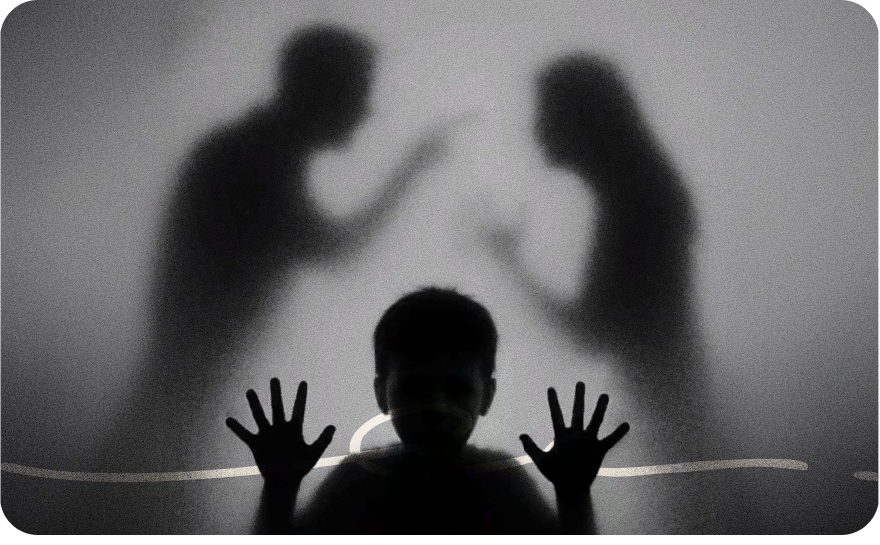
When people spoke about broken homes, they often spoke as though they were discussing a collapsed building.
A roof caved in, walls shattered, a family destroyed.
But that was never how Samuel understood it, his home never broke in a single moment.
It cracked quietly, patiently, like glass developing invisible fractures long before it finally shatters.
The first crack appeared when he was seven, his parents were sitting at opposite ends of the dining table. Nothing dramatic happened that evening. No shouting. No insults.
His mother served dinner, his father ate, and the television played in the background.
Yet Samuel remembered feeling something strange. Neither of them looked at the other.
Two people occupying the same space while living in different worlds.
At seven years old, he could not explain what he was seeing.
At thirty-two, he understood.
Sometimes a family begins to die long before anyone notices the funeral.
As the years passed, arguments became frequent visitors. Some were loud, others were silent.
Samuel eventually discovered that silence could be far more violent than shouting.
Words leave wounds, silence leaves questions and questions can haunt a child for decades.
When his parents were finally separated, relatives said the usual things.
"Children are resilient", "He'll be fine", "Time heals everything."
People said these things because they were comforting, not because they were true.
Time does not heal everything, sometimes time simply teaches people how to hide their wounds.
Samuel became exceptionally good at hiding, at school, teachers praised his maturity, friends admired his independence and adults called him responsible.
Nobody realized that what they called maturity was often fear. Children who grow up too quickly are rarely growing.
More often, they are surviving, he learnt never to need too much from anyone, the need was dangerous.
Need gave people power to disappoint you, so he built his life around self-sufficiency.
He studied alone, worked alone, dreamed alone and succeeded alone.
People admired his strength, they never saw the loneliness hidden inside it.
Years later, he entered his first serious relationship. Ada loved him deeply, or at least she tried to.
Whenever she showed affection, he became uncomfortable, whenever she offered reassurance, he doubted her sincerity.
Whenever she spoke about marriage, he changed the subject.
He wanted love, desperately. Yet every time love approached him, he treated it like an intruder.
One evening Ada asked him a question he could not answer. "Why do you keep testing me?"
Samuel laughed. "What do you mean?"
"You always expect me to leave", she paused.
"You create situations that push me away, then wait to see if I'll stay."
For a moment he felt exposed.
Like a man suddenly discovering that everyone could see the scars he thought he had hidden.
That night he realized something unsettling.
He had spent years blaming his parents for teaching him what love was not.
Yet he had never learned what love actually was.
The absence of a lesson is not the same as the lesson itself.
He knew how relationships failed, he did not know how they survived.
The relationship ended two years later,not because Ada stopped loving him.
But because love alone was not enough.
That realization haunted him.
As a child, he had imagined that love was the solution to everything.
As an adult, he discovered that love, by itself, could be astonishingly powerless.
People often think marriages collapse because love disappears.
But Samuel had seen marriages where love remained long after respect had died.
Long after trust had died.
Long after discipline, sacrifice, and commitment had died.
Love was important. But it was not sufficient.
The discovery unsettled him because it forced him to reconsider his parents.
For years, he had cast them as villains in the story of his suffering.
It was easier that way, children prefer simple narratives, heroes, villains, victims.
But adulthood complicates every story.
One day he asked his mother a question.
"Did you ever love Dad?"
She looked at him for a long time, then she laughed softly.
"The tragedy is that I did."
The answer disturbed him more than hatred ever could. Because if love existed, why had everything collapsed?
For the first time, Samuel began examining his parents not as symbols, but as human beings.
Two flawed people, two wounded people, two unprepared people.
His father had entered marriage carrying unresolved anger.
His mother had entered it carrying unrealistic expectations.
Neither possessed the emotional tools necessary to sustain a family.
Both assumed love would compensate for everything else.
Neither understood that affection cannot replace character nor can attraction replace maturity, or can good intentions replace preparation.
The older Samuel became, the more frightening this realization felt.
Because it meant the greatest threat to his future family was not his parents.
It was himself.
He carried the same capacity for selfishness, the same pride, the same emotional blind spots, the same tendency to avoid difficult conversations, the same fear of vulnerability.
Inheritance, he discovered, was not merely genetic. People inherit patterns, habits, wounds and unless examined, those wounds become family traditions.
For years Samuel blamed his broken home for everything.
His distrust, his loneliness, his fear, his failures.
And in many ways, the blame was justified.
But eventually another truth emerged, the past explained him, it did not own him.
There was a difference, a crucial difference.
One gave understanding.
The other surrendered responsibility.
Many people spend their entire lives confusing the two. They turn their pain into an identity.
Their wounds become a permanent residence rather than a temporary injury.
Samuel nearly did the same.
Until he realized that trauma, left unchallenged, often seeks reproduction.
The wounded frequently wound others, not because they are evil.
But because pain rarely remains stationary.
It moves, it spreads, it seeks new hosts.
Years later, standing beside the woman he would eventually marry, Samuel found himself terrified.
Not of commitment, not of fatherhood, but of repetition.
He feared becoming another chapter in the same story.
That fear forced him into preparation.
He sought counsel, he confronted his weaknesses, he learnt financial discipline.
He developed emotional awareness, he deepened his spiritual life, he learnt that communication was a skill.
That forgiveness required practice.That humility was not weakness.
That love was not merely a feeling but a responsibility and perhaps most importantly, he learnt that marriage is not sustained by finding the right person.
It is sustained by becoming the right person.
On the day of his wedding, Samuel looked at the guests gathered around him.
Among them sat his mother, a few rows away sat his father.
Separated, aged.
Still carrying the consequences of choices made decades earlier.
For a moment he felt sadness, not anger, not resentment.
Only sadness.
Because he finally understood something he had spent his entire life trying to avoid.
Broken homes do not merely produce broken children.
They produce children forced to answer questions they never asked.
What is love?
What is commitment?
Can people truly stay?
Can trust survive disappointment?
Can families heal?
Some answer those questions poorly.
Some never answer them at all.
But every child must eventually decide.
As Samuel exchanged vows, he understood that his future family would not survive on love alone.
It would require preparation, spiritual preparation, emotional preparation, financial preparation, mental preparation and moral preparation.
Because families are not destroyed only by cruelty.
Many are destroyed by immaturity, and children, who never chose the conflict, often spend years carrying its consequences.
The greatest lesson of his life was not that broken homes create wounded people.
It was that wounds become dangerous when people refuse to examine them.
And so, standing before God, his family, and his future, Samuel made a quiet promise.
Not that his marriage would be perfect, no marriage is.
But that he would never assume love was enough.
Because houses are built with materials.
Homes are built with preparation.